Description
Dinstar SBC3000 500–2000 Session Border Controller for SIP Trunks Dubai
The SIP trunk is live. The call centre is ready. The PABX has the routes. Then the first Dubai test call exposes the real problem: outside callers can see too much of the voice network, NAT is rewriting media the wrong way, one branch is sending calls with a different numbering format, and the security team wants to know why SIP traffic is touching the enterprise edge without a voice firewall in front of it.
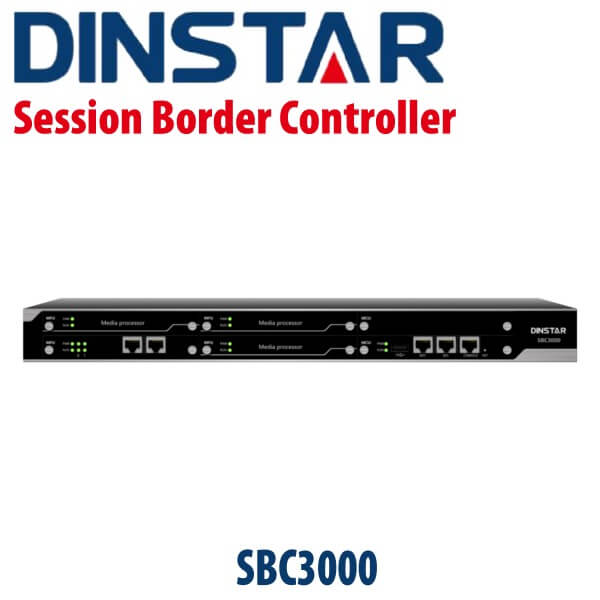
That is where the Dinstar SBC3000 belongs. Not beside one desk. Not for a small office with ten extensions. This is the session border controller for large enterprise SIP trunks, service-provider edges, operator interconnects, call-centre voice networks, and multi-site PABX projects where signalling, media, registration, routing, and security all need to be controlled before traffic reaches the internal system.
Vector Digital Systems supplies the Dinstar SBC3000 from Dubai for projects where the buyer needs a real session count, a stated licence tier, staged SIP routing, and no surprises on handover. We configure the SIP trunk side, the customer platform side, routing rules, number manipulation, access control, and management enrolment before dispatch.
What the SBC3000 is built to sit between
A session border controller sits at the border of a voice network. One side faces the outside world: Etisalat SIP trunk, du SIP trunk, wholesale SIP carrier, operator interconnect, hosted voice customer, or remote branch. The other side faces the internal voice platform: the enterprise PABX, softswitch, contact-centre platform, hosted voice core, or voice application server.
The Dinstar SBC3000 controls what passes between those two sides. It hides the internal voice topology, handles SIP and media across NAT, blocks malformed SIP traffic, applies routing rules, limits request rates, manipulates caller and called numbers, records CDR data, and gives the engineer packet capture and logs when a trunk provider says, “the problem is on your side.”
For a Dubai project buyer, this matters because the problem is rarely just “does the trunk register?” The real work is in making Etisalat, du, branch sites, remote users, and the customer’s PABX speak the same routing language without exposing the internal voice system. The SBC3000 gives the project team one controlled voice edge instead of a loose set of firewall rules and trunk-side workarounds.
SBC sizing starts with sessions, not extensions
An extension count tells you how many users exist. A session count tells you how many concurrent call legs the SBC must carry at the border. A 600-user office may need far fewer than 600 external sessions. A service-provider edge with fewer registered customers may still need a higher session tier because calls overlap heavily. Send us the trunk count, expected busy-hour calls, codec requirement, and growth plan on WhatsApp and we confirm the right model.
The licence question that must be answered before procurement
The Dinstar SBC3000 is a scalable SBC family, not a single fixed call count in every quotation. It is specified for 500 to 2000 SIP sessions and 300 to 1200 transcoding sessions. That range is useful only if the quote says exactly what is included in the unit being supplied.
This is the buyer trap. A project document may say “SBC3000” and the engineer may assume 2000 sessions, while the commercial quote may be for a lower session tier. Or the SIP session count may be enough, but transcoding is undersized because nobody checked whether calls need codec conversion between the carrier side and the customer side. That mistake appears at commissioning, not at purchase order stage, and it is expensive to fix under pressure.
Licence tier must be written on the quote
For the Dinstar SBC3000, we confirm the included SIP session tier and the included transcoding tier before dispatch. Do not approve an SBC quote that only says “SBC3000” without stating the session licence. We write the supplied tier into the quotation so the integrator, consultant, and customer all know what will be commissioned.
The plain sizing method is simple. Count the concurrent call paths that cross the border. Calls from the SIP trunk into the PABX count. Calls from the PABX out to the SIP trunk count. Calls between hosted customers through the SBC count. Calls that need codec conversion also consume transcoding capacity. If the project uses mixed codecs, branch links, recording systems, or carrier-side requirements that differ from the internal platform, transcoding must be checked separately from SIP sessions.
For smaller edges, the Dinstar SBC1000 may be enough. For larger operator or hosted voice cores, the SBC3000 Pro or software SBC range may be the better fit. The SBC3000 sits in the middle: large enough for serious enterprise and provider work, still a 1U hardware appliance that fits cleanly into a Dubai comms room or data-centre rack.
Why a firewall is not enough for SIP trunks
Firewalls inspect network traffic. An SBC understands SIP conversations. That difference matters. Voice traffic has signalling and media. It has registration behaviour, request rates, caller ID rules, codec negotiation, trunk failover, NAT traversal, and fraud patterns. A normal firewall may pass packets while the call still has one-way audio, failed transfers, exposed private IP addresses, or open signalling paths that should never reach the internal PABX.
The SBC3000 works as a back-to-back user agent. It terminates one SIP leg and creates another. That lets it clean up headers, control media, hide private addressing, apply number rules, and protect the customer system from direct exposure. In plain English: the carrier sees the SBC, not the PABX. The internal voice system sees the SBC, not the outside network.
For a Dubai enterprise moving to Etisalat or du SIP trunks, this reduces the amount of custom trunk behaviour pushed into the PABX. For an IT company supporting many sites, it creates one repeatable edge design. For a service provider, it becomes the controlled line between customer traffic and the provider core.
The security layer: SIP anti-attack, TLS/SRTP, and topology hiding
The SBC3000 includes SIP anti-attack functions, malformed packet protection, DoS and DDoS prevention, policy-based anti-attack rules, access lists, white list and black list handling, SIP request rate limiting, SIP registration rate limiting, and scan attack detection for SIP registration and SIP calls. These are not brochure decorations. They are the controls that decide which signalling is allowed to reach the voice system at all.
It also supports TLS for SIP signalling and SRTP for media, where the connected platforms and carriers support those modes. In staging, we check which side needs encrypted signalling, which side stays plain SIP, and whether the project needs media encryption end to end or only across a given network segment. Security only works when the connected systems agree on the same method.
Topology hiding is the other part buyers often miss. Without an SBC, SIP headers can expose private IP ranges, platform names, routing hints, and internal addressing. The SBC3000 rewrites what the outside side is allowed to see. For banks, call centres, government contractors, hospitality groups, and service providers in the UAE, that is a design requirement, not a nice extra.
Dubai staging note: We stage the SBC3000 with SIP trunk details, routing rules, number manipulation, access rules, codec settings, HA plan, management access, and test calls before delivery. For multi-site projects, we prepare the route plan as one batch so branches do not become separate one-off fixes.
Where the SBC3000 fits in real projects
The strongest fit is a voice edge with enough traffic, risk, or customer impact to justify a dedicated SBC. A DIFC office moving a large PABX estate to SIP trunks. A DMCC call centre with heavy inbound and outbound traffic. A service provider aggregating customer SIP trunks. A hotel group with centralised SIP trunks and site-level routing. A bank branch network that needs controlled voice paths between branches, data centre, and carrier.
The Dinstar SBC3000 gives those projects a defined border: SIP enters here, is checked here, is rewritten here, is routed here, and is logged here. It supports unlimited SIP trunks, up to 5000 SIP registrations, 200 calls per second, CDR reporting and export, network capture, system logs, statistics, and common troubleshooting tools such as ping and tracert. That is why it belongs in the project design before the trunk is ordered, not after the first failed call test.
For broader model selection, use the SBC sizing page. For mixed voice projects that also include analog gateways, E1 gateways, or wireless gateways for lawful operator deployments, use the Dinstar gateway selector before finalising the bill of materials.
Deployment truth: HA, power, rack, and management
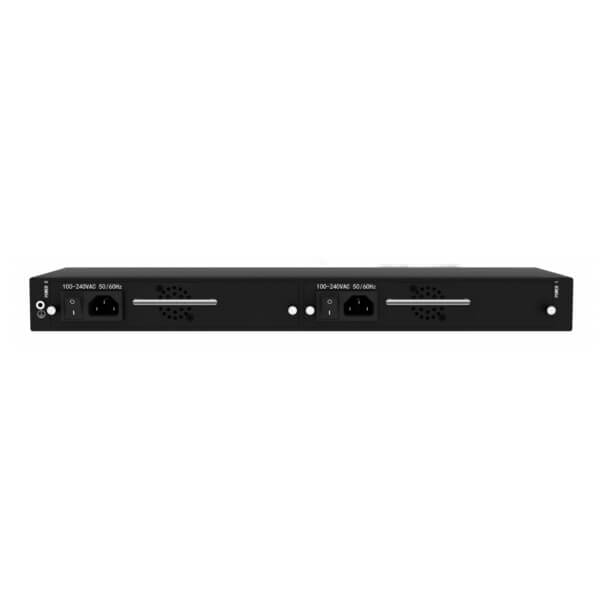
The SBC3000 is a 19-inch 1U hardware SBC with dual redundant 100–240V AC power supply. In a proper Dubai deployment, it is not treated as a loose appliance under a desk. It belongs in the voice rack, with carrier-side and customer-side network placement documented, management access locked down, and the high-availability design agreed before cutover.
Dinstar publishes 1+1 active/standby HA support for the SBC3000. For project teams, that means the HA pair must be planned as a pair, not bought as two unrelated boxes. The active unit handles traffic, the standby unit is prepared to take over if the active side fails. IP addressing, link placement, signalling routes, heartbeat behaviour, and trunk-side acceptance all need to be tested with the actual project design.
Management is handled through web GUI, SNMP, automated provisioning, configuration backup and restore, CDR export, system logs, statistics, packet capture, ping, and tracert. Dinstar cloud management can be used where the project allows it. For service providers and multi-branch enterprises, that gives the voice team a single place to see route behaviour, call records, trunk health, and troubleshooting data instead of logging into the customer PABX every time a carrier test fails.
What we stage before dispatch
SIP trunk peers, customer-side SIP platform, routing policy, number manipulation, codec rules, access lists, TLS/SRTP settings where required, CDR export, management access, HA plan, and test-call paths. For provider projects, we stage a route sample and a repeatable configuration method before the units leave Dubai.
Current Dinstar SBC family direction: when to step up
The SBC3000 remains the clean fit for many large enterprise and provider-edge projects because it sits in the 500 to 2000 SIP-session range with 300 to 1200 transcoding sessions, 200 calls per second, 5000 SIP registrations, 1+1 HA, dual power, and 1U rack mounting. That is enough for many SIP trunk migrations, call-centre edges, and hosted voice borders in the UAE.
The newer SBC3000 Pro sibling is the step-up when the project grows beyond that range. It is the better discussion when the buyer asks for up to 5000 SIP sessions, higher registration scale, WebRTC voice, SIPREC recording integration, or heavier encrypted media requirements. The software SBC range is a different path again, used when the design needs cloud or server deployment rather than a fixed 1U hardware appliance.
That is why we do not quote the SBC3000 blindly. We ask for the expected concurrent sessions, transcoding need, registration count, carrier count, encryption requirement, HA requirement, and growth plan. Sometimes the SBC3000 is right. Sometimes the SBC1000 saves budget. Sometimes the SBC3000 Pro or SBC8000 avoids a second purchase one year later.
Platform compatibility in Dubai projects
The SBC3000 speaks SIP 2.0 over UDP, TCP, and TLS. It can sit between Etisalat or du SIP trunks and the customer voice platform, between a service-provider softswitch and customer trunks, or between a hosted voice core and remote enterprise sites. It supports SIP trunk access, peer-to-peer SIP trunking, NAT traversal, static routes, QoS marking with ToS and DSCP, caller and called number manipulation, and dynamic load balancing.
During staging, we map the carrier format to the customer format. That includes caller ID presentation, national and international dial patterns, emergency routing rules where the customer requires them, extension-to-DID mapping, branch prefixes, failover routes, blocked destinations, and any test numbers the project consultant wants documented. This is where many SIP trunk projects win or lose time.
Teams Direct Routing note
Do not treat the SBC3000 as Microsoft-certified unless the exact model appears on Microsoft’s current certified SBC list at the time of quotation. For Teams calling projects, we check the current requirement before quoting and avoid certification claims that the manufacturer or Microsoft list does not support.
Dinstar SBC1000 vs SBC3000 vs SBC3000 Pro vs SBC8000
| Model | Published scale | Best fit | Verdict |
|---|---|---|---|
| Dinstar SBC1000 | 50–500 SIP sessions, 50–200 transcoding sessions | Medium enterprise SIP edge, smaller call centre, controlled trunk migration | Choose it if 500 sessions is enough and growth is limited. |
| Dinstar SBC3000 — this unit | 500–2000 SIP sessions, 300–1200 transcoding sessions | Large enterprise, service provider edge, operator interconnect, heavy SIP trunk projects | Choose it when the SBC1000 is too small but a 5000-session design is not needed. |
| Dinstar SBC3000 Pro | 500–5000 SIP sessions, 300–1500 transcoding sessions | Higher registration scale, WebRTC voice, SIPREC, heavier SRTP projects | Choose it when the growth plan already points past SBC3000. |
| Dinstar SBC8000 | Software SBC, up to 50,000 concurrent call sessions | Cloud, VM, data-centre, and carrier-scale deployments | Choose it when hardware appliance sizing is no longer the right architecture. |
The simple verdict: choose SBC1000 for a smaller edge, SBC3000 for large enterprise and provider work up to 2000 SIP sessions, SBC3000 Pro when 5000-session planning or newer media features are part of the brief, and SBC8000 when the design belongs on software infrastructure. For E1-to-SIP migration projects, pair the SBC discussion with the Dinstar MTG2000 where legacy digital trunks still exist.
Pricing, supply, and staging from Dubai
Dinstar SBC3000 pricing depends on the included SIP session tier, transcoding tier, HA requirement, quantity, and project staging scope. We do not publish fixed AED pricing because one SBC3000 quote may be a single appliance for an enterprise SIP trunk, while another may be an HA pair for a service-provider edge with documented route policy and export packing.
Vector Digital Systems supplies, stages, and configures Dinstar SBC units from Dubai. Same-day AED quote on WhatsApp for standard requests. For project quantities, we include VAT breakdown, delivery, configuration scope, warranty handling, and the exact licence tier being supplied. For export, we quote FOB Dubai with documentation.
Stock & Projects: Dinstar SBC3000 supplied from Dubai with same-day AED quote on WhatsApp. Supply and installation across all 7 UAE emirates. Project quantities, HA pairs, licence-tier confirmation, staging, and MEA export — FOB Dubai pricing on request.
Frequently asked questions
How many sessions does the Dinstar SBC3000 support and what licence is included?
Dinstar publishes the SBC3000 range as 500 to 2000 SIP sessions and 300 to 1200 transcoding sessions. The included licence tier must be confirmed on the quotation before purchase. Vector Digital Systems writes the supplied SIP session tier and transcoding tier into the quote so the project team knows exactly what will be commissioned.
Will the SBC3000 work with Etisalat and du SIP trunks?
Yes, the SBC3000 is used as the controlled SIP edge between licensed UAE SIP services and the customer voice platform. During staging, we configure SIP peers, routing rules, number manipulation, codec policy, access lists, and test calls for the Etisalat or du trunk design.
SBC3000 vs SBC1000 — what is the difference?
SBC1000 is the smaller model, published for 50 to 500 SIP sessions and 50 to 200 transcoding sessions. SBC3000 steps up to 500 to 2000 SIP sessions and 300 to 1200 transcoding sessions, with 200 calls per second and 1+1 HA support. Choose SBC1000 for smaller enterprise edges and SBC3000 for larger enterprise, provider, and operator projects.
SBC3000 vs SBC3000 Pro — when should we step up?
Choose SBC3000 when the project fits inside the 500 to 2000 SIP-session range and needs a 1U hardware SBC with HA, SIP security, and carrier-edge routing. Step up to SBC3000 Pro when the design needs up to 5000 SIP sessions, higher registration scale, WebRTC voice, SIPREC, or heavier encrypted media planning.
Does Vector Digital Systems configure the SBC3000 before delivery?
Yes. Staging includes SIP trunk peers, customer-side SIP platform details, route policy, number manipulation, codec rules, access lists, TLS/SRTP settings where required, management access, CDR export, HA planning, and test-call paths before dispatch.
Is the Dinstar SBC3000 Microsoft Teams certified?
We do not claim Microsoft Teams certification for the SBC3000 unless the exact model appears on Microsoft’s current certified SBC list at the time of quotation. For Teams Direct Routing projects, Vector Digital Systems checks the current Microsoft requirement before quoting the SBC design.
Is VoIP legal in the UAE and can an SBC be used with licensed operators?
Business VoIP over licensed operators is standard in the UAE under TRA regulation. The SBC3000 is used to secure and control lawful SIP trunk deployments with Etisalat, du, and approved enterprise or service-provider voice networks. It is not a tool for bypassing UAE telecom regulation.
Is the Dinstar SBC3000 covered under Dinstar warranty in the UAE?
Yes. Vector Digital Systems supplies the Dinstar SBC3000 with Dinstar manufacturer warranty, local warranty handling from Dubai, and project documentation for procurement teams, consultants, IT companies, and system integrators.
Who is the supplier of Dinstar SBC3000 in Dubai?
Vector Digital Systems LLC is an authorised Dinstar supplier in Dubai, UAE, operating since 2009. We supply the Dinstar SBC3000 with session licence confirmation, staging, configuration, installation across all seven emirates, warranty handling, and official supplier documentation for project buyers.
What is the best Dinstar SBC for a large SIP trunk project in Dubai?
For large enterprise and service-provider SIP trunk projects that need 500 to 2000 SIP sessions, 300 to 1200 transcoding sessions, 1+1 HA, SIP anti-attack controls, TLS/SRTP, CDR export, and staged routing, the Dinstar SBC3000 is the right middle tier. Smaller edges suit SBC1000. Projects already planning beyond 2000 sessions should look at SBC3000 Pro or SBC8000.
Does Vector Digital Systems export Dinstar SBC3000 from Dubai?
Yes. Vector Digital Systems exports Dinstar SBC3000 units from Dubai to service providers, ISPs, system integrators, and enterprise voice teams in Saudi Arabia, Oman, Qatar, Kuwait, Bahrain, Iraq, Kenya, Tanzania, Nigeria, and Ghana. Export quotes are FOB Dubai with commercial invoice, packing list, certificate of origin, and Dinstar manufacturer warranty.
UAE coverage — all seven emirates
Vector Digital Systems supplies, installs, and stages the Dinstar SBC3000 across Dubai, Abu Dhabi, Sharjah, Ajman, Ras Al Khaimah, Fujairah, and Umm Al Quwain. We support SIP trunk and PABX projects in free zones and business districts including DIFC, DMCC, JAFZA, Dubai Internet City, Dubai Silicon Oasis, Abu Dhabi Global Market, Hamriyah Free Zone, and RAKEZ. One project can include Dubai staging, Abu Dhabi installation, Sharjah branch routing, and export packing under the same quotation.
MEA export from Dubai
Dinstar SBC3000 export buyers are usually service providers, ISPs, system integrators, IT distributors, telecom operators, and enterprise voice teams building SIP trunk or hosted voice borders. From Dubai, we support Gulf projects into Saudi Arabia, Oman, Qatar, Kuwait, Bahrain, and Iraq, plus African deployments into Kenya, Tanzania, Nigeria, and Ghana.
Export supply is quoted FOB Dubai with commercial invoice, packing list, certificate of origin, and Dinstar manufacturer warranty. For SBC projects, send the destination, required session tier, transcoding need, quantity, power requirement, and whether the units need staging before export packing.
Get a quote for Dinstar SBC3000
Dubai supply · Licence tier confirmed · Staged before dispatch · Project quantities and export