Description
Dinstar SBC300 5 to 50 Session SIP Session Border Controller Dubai
The SIP trunk is live. Etisalat or du has handed over the service, the PABX is registered in the rack, and the phones in the Dubai office are ready. Then the first test call gives the project its real problem: one-way audio, public IP exposure, NAT rules that nobody wants to own, and a customer asking whether branch traffic, operator SIP, and remote users are all going through the same edge.
That is where a session border controller earns its place. Not as another box for the drawing. As the line between the private voice network and the outside SIP world. The Dinstar SBC300 is the entry Dinstar SBC for small and mid-size deployments that still need proper SIP control: trunk protection, topology hiding, NAT traversal, media handling, TLS/SRTP, SIP firewall rules, routing, and call records.
For UAE project buyers, the important part is not just “SBC300”. It is the session licence tier quoted with the unit. Dinstar positions the SBC300 from 5 to 50 SIP sessions, with matching 5 to 50 transcoding calls depending on the selected licence. Vector Digital Systems quotes the licence tier as part of the project, stages the SIP trunk, and tests the call path before dispatch. No surprise at commissioning.
What the SBC300 is built to do
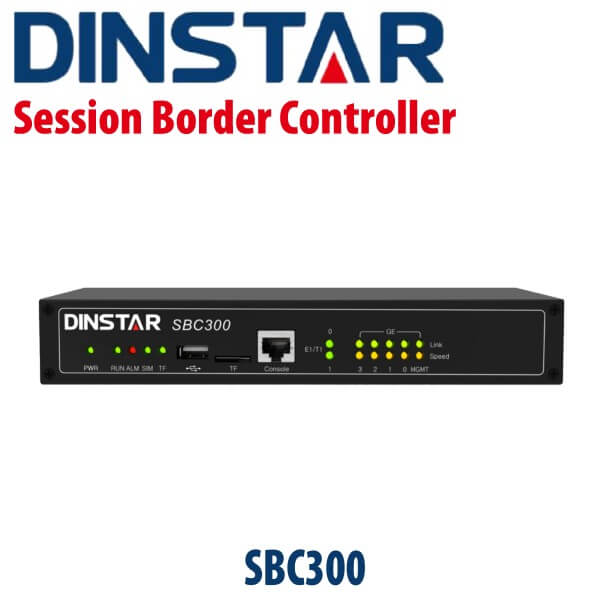
The Dinstar SBC300 is a SIP session border controller for business voice networks. It sits between your private PABX or voice platform and the outside SIP network. That outside network may be an Etisalat SIP trunk, a du SIP trunk, an operator interconnect, a hosted voice platform, or a SIP peering arrangement for a service provider.
Inside the office, the PABX sees a controlled SIP peer. Outside, the carrier or upstream platform sees the SBC. The customer’s internal IP addressing, extension structure, branch routing, and voice topology are not exposed. Calls are normalised, routed, recorded in CDR, and inspected at the border before they move across the network.
This matters in Dubai projects because SIP trunking rarely arrives into a perfect lab network. The PABX may be on a private VLAN. The firewall may already carry ERP, CCTV, VPN, and guest Wi-Fi. Some branches may reach the head office across VPN. The customer may want remote extensions later. A flat SIP trunk into the PABX can work on a small clean site, but once the design includes NAT, branches, public access, or a strict security team, the SBC becomes the safer boundary.
The SBC300 is the smaller member of the Dinstar SBC range, so it suits offices, clinics, trading companies, warehouses, branch networks, and integrator-managed customer sites where the session count is modest but the SIP edge still needs to be managed properly.
Sessions, licences, and the mistake to avoid
Analog gateways are counted by ports. E1 gateways are counted by E1 spans and voice channels. SBCs are different. They are sized by concurrent sessions.
One SIP session usually means one active call leg through the SBC. If ten users are on external calls at the same time, the project needs enough licensed sessions to carry those calls. Registered extensions are not the same as live sessions. A site may have 80 users but only 10 to 20 concurrent external calls during peak hours. That is why the session count must be designed, not guessed.
Transcoding is the second count. Dinstar lists the SBC300 with 5 to 50 transcoding calls. Transcoding is used when one side of the call uses a different codec from the other side and the SBC has to translate between them. For example, one network may require G.711 while another side uses G.729, iLBC, AMR, OPUS, or another supported voice codec. Not every call needs transcoding, but when it does, it consumes transcoding capacity.
Licence tier must be written in the quote
The SBC300 family scales from 5 to 50 SIP sessions. Do not approve a quote that says only “SBC300” without the session licence tier. Vector Digital Systems states the selected tier on the quotation and sizes it against your expected concurrent calls before staging.
For a small office with 5 to 8 peak external calls, the lower SBC300 tier may be enough. For a busier Dubai sales office, a clinic with reception traffic, or a warehouse with branch-to-head-office calling, the 10 or 20 session tier may make more sense. For a site that is already close to 50 sessions, the sizing conversation should include the step-up Dinstar models as well, because growth after go-live is easier to handle before the box is ordered.
The 60-second sizing check
Tell us the number of users, expected peak outside calls, SIP trunk channels, codec requirement, and whether branches or remote users pass through the same edge. We map that to the SBC300 licence tier or advise the next Dinstar SBC. Send us your requirement on WhatsApp and we confirm the right model.
Why a small SBC still needs serious security controls
The SBC300 may sit in small and mid-size projects, but the threats at the SIP edge are the same ones larger networks face. SIP registration scans. Flooding. Bad packets. Toll fraud attempts. Unwanted peers. Traffic bursts that make troubleshooting look like a carrier problem when the real issue is at the public edge.
Dinstar gives the SBC300 the core protections needed for that role: topology hiding, VoIP firewall features, DoS and DDoS protection, SIP and RTP flooding protection, malformed packet protection, ACL rules, dynamic white and black lists, bandwidth limitation, traffic control, SIP request and registration rate limiting, and scan-attack detection.
The practical result is simple. Your PABX is no longer the first device exposed to every SIP request. The SBC becomes the controlled entry point. It decides which peers are trusted, which SIP messages are allowed, how traffic is routed, and which calls should be rejected before they reach the voice platform.
This is a strong fit for system integrators maintaining several client sites across Dubai, Sharjah, Abu Dhabi, and the northern emirates. The customer gets a cleaner voice edge. The installer gets a repeatable design. Support gets logs, CDR, capture tools, and a single border to inspect when a call fails.
SIP repair at the border
Not every SIP problem is a fault. Many are mismatches. One side sends signalling in a format the other side does not like. Caller ID needs to be rewritten. The SIP trunk expects one numbering plan while the PABX sends another. NAT hides the wrong address in the SIP message. Codec negotiation passes in testing, then fails when a different call route is used.
The SBC300 handles SIP mediation and routing at the border. It supports SIP 2.0 over UDP, TCP, and TLS, operates as a B2BUA, works with SIP trunk access and peer-to-peer modes, and provides routing control for the live call path. For Dubai deployments with Etisalat or du SIP trunks, that gives the installer a place to normalise traffic before it reaches the customer’s PABX.
It also supports NAT traversal and QoS functions, which is where many small projects benefit from an SBC even when the session count is not high. One-way audio is often caused by address translation and media path issues, not the phones. The SBC gives the project a voice-aware edge instead of asking a general firewall to understand every SIP and RTP behaviour.
During staging, Vector Digital Systems sets the SIP peer, trunk parameters, routing logic, access rules, and test calls against the intended platform. For project quantities, each unit can be labelled and staged for its branch or customer site before dispatch from Dubai.
Teams calling: useful in projects, but do not call it certified
Many UAE buyers ask the same question: can this help with Teams calling or Direct Routing projects? The careful answer is that Dinstar has published deployment material for connecting SBCs with Microsoft Teams Direct Routing, and the SBC300 can sit in SIP designs where Teams, PABX, and carrier trunks are part of the discussion.
But certification language matters. Microsoft keeps its own certified SBC list, and Dinstar SBC300 should not be described as Microsoft-certified unless that list names it. For procurement, support, and consultant submissions, Vector Digital Systems will not write “Teams certified” for the SBC300. We size and stage the SIP design according to what the project actually needs, and we mark certification-sensitive requirements before quoting.
Project note for Teams and hybrid voice
If the consultant specification requires a Microsoft-certified SBC, tell us before approval. If the requirement is SIP trunk control for a PABX, branch, operator, or hybrid voice design, the SBC300 can be sized by sessions and staged against the real call flow.
Where SBC300 fits in Dubai projects
Use the Dinstar SBC300 when the customer has a real SIP edge but not a large carrier-grade call volume. Typical fits include a 3CX office with an Etisalat SIP trunk, a Yeastar or Asterisk PABX that needs better trunk security, a Grandstream UCM site with NAT issues, a branch office that needs controlled SIP peering to head office, or a service provider managing several small customer networks.
It is also useful when the customer has grown past “just register the trunk to the PABX”. That direct method may pass a quick test, but it leaves the PABX doing too many jobs: security, SIP repair, routing, logging, and public-edge behaviour. The SBC300 moves those jobs to a device built for the border.
For bigger trunks, more active calls, multi-tenant hosting, or heavier provider interconnect, the Dinstar SBC1000, SBC3000, SBC3000 Pro, or SBC8000 should be compared before approval. The SBC sizing page is the right starting point for that decision. If the project includes analog gateways, E1 gateways, or wireless gateways as well, map the full voice edge on the VoIP gateway selector before ordering.
Deployment truth: what we stage before dispatch
An SBC is not a plug-in-and-hope appliance. The value is in the border design. Before a Dinstar SBC300 leaves our Dubai staging bench, Vector Digital Systems maps the SIP peers, trunk direction, registration method, codec rules, NAT behaviour, access controls, routing, caller ID handling, and test numbers. The aim is simple: when the integrator reaches site, the unit is already behaving like part of the customer’s voice network.
For Etisalat and du SIP trunk jobs, we normally ask for the trunk handover details, public or private IP plan, PABX platform, expected concurrent calls, codec requirement, and whether any branches, remote users, call recording servers, or hosted voice platforms pass through the same edge. That tells us whether the SBC300 licence tier is right, or whether the project should move up the Dinstar range before purchase.
The SBC300 gives the installer a practical toolset for support: web management, SNMP, automated provisioning, cloud management, configuration backup and restore, system logs, network capture, ping, tracert, statistics, and CDR export. That matters after handover. When a Dubai office says “calls are dropping,” support can inspect the voice border instead of guessing across the PABX, firewall, carrier, and handsets.
Staging before dispatch: SIP peers created, Etisalat or du trunk parameters entered where supplied, routing and caller ID rules configured, codec preference checked, ACL and security rules applied, NAT/media behaviour tested, CDR enabled, management access set, and test calls completed before the unit is released.
Current capabilities worth writing into the design
The SBC300’s current feature set is strong enough for many SME and branch projects without moving into a larger chassis. It supports SIP trunk access and peer-to-peer modes, B2BUA operation, SIP 2.0 over UDP, TCP, and TLS, NAT traversal, QoS, routing control, media handling, and codec support across G.711A/U, G.723.1, G.729A/B, iLBC, AMR, and OPUS.
For security, the page should not hide behind vague wording. The useful controls are specific: topology hiding, VoIP firewall functions, DoS and DDoS protection, SIP and RTP flooding protection, malformed packet protection, SIP request and registration rate limiting, registration scan attack detection, ACL rules, dynamic white and black lists, bandwidth limitation, traffic control, TLS, and SRTP.
Those are not only “IT security” features. They fix real voice problems. Topology hiding keeps the customer’s internal voice network private. TLS and SRTP protect signalling and media where the project uses encrypted paths. SIP rate limits help control scans and bursts. Codec handling reduces failure between platforms that do not agree on media. CDR export gives billing, audit, and support teams something they can read after the call.
Platform compatibility in UAE projects
The Dinstar SBC300 is commonly positioned between SIP trunks and platforms such as 3CX, Grandstream UCM, Yeastar, Asterisk, Cisco voice systems, Avaya estates, hosted PABX platforms, and operator SIP networks. In Dubai, the common design is simple on paper: Etisalat or du SIP service on one side, business PABX on the other. The real work is making the signalling, media, caller ID, registration, and security rules agree.
For 3CX and Yeastar deployments, the SBC300 is useful when the customer wants a controlled SIP edge rather than exposing the PABX directly. For Grandstream UCM and Asterisk sites, it gives the installer a cleaner border for NAT, trunk routing, and codec handling. For older Cisco or Avaya estates, it can sit in the migration path when SIP trunking is introduced and the existing call control still has to remain stable.
For service providers and integrators, the SBC300 is also a repeatable customer-edge appliance. The same design can be staged across multiple small offices, clinics, warehouses, and branch sites, with each unit labelled by customer, branch, trunk, licence tier, and management credentials before dispatch from Dubai.
SBC300, SBC1000, or SBC3000 — choose by sessions, not habit
| Dinstar SBC choice | Where it fits | Buyer decision |
|---|---|---|
| SBC300 lower licence tier | Small office SIP trunk, light external call traffic, controlled PABX edge | Choose it if peak calls are low and growth is limited |
| SBC300 — this model | 5 to 50 SIP sessions, 5 to 50 transcoding calls, up to 1,000 SIP registrations | Choose it for small and mid-size UAE sites that need SIP trunk protection without a larger SBC tier |
| SBC1000 | Step-up Dinstar SBC tier for larger call volume and wider deployment headroom | Choose it if the SBC300 sits near its upper session range or the project will grow |
| SBC3000 | Larger provider, enterprise, or multi-site voice edge projects | Choose it when the project is no longer an SME edge and needs a bigger Dinstar SBC class |
Verdict: choose the SBC300 when the session count is inside the 5 to 50 range and the job is a controlled SME, branch, or customer-edge SIP trunk deployment. Choose the SBC1000 if the design is already close to the SBC300 ceiling. Choose the SBC3000 when the project moves toward larger enterprise, service provider, or multi-site voice edge requirements. For a full model path, start with the Dinstar SBC sizing guide.
Pricing, supply, and project quantities from Dubai
Dinstar SBC300 pricing depends on the selected session licence tier. Vector Digital Systems does not quote it as a vague line item because the licence is part of the working design. Send the expected concurrent call count, SIP trunk channel count, PABX platform, codec requirement, and site count. We reply with the correct SBC300 tier or the correct Dinstar step-up model.
Same-day AED quotation is available for UAE project buyers, with VAT breakdown and delivery included. For system integrators, PABX installers, IT companies, and resellers, we can stage multiple SBC300 units as one project batch before dispatch. Each unit can be tagged for its customer site, management access, trunk side, LAN side, and licence tier.
Get a quote for Dinstar SBC300
Session licence confirmed · Same-day AED quote · Staged in Dubai · Project quantities and export
Frequently asked questions
How many sessions does the Dinstar SBC300 support and what licence is included?
The Dinstar SBC300 scales from 5 to 50 SIP sessions, with 5 to 50 transcoding calls depending on the selected licence tier. Vector Digital Systems states the selected session licence on the quotation, so the buyer knows what the supplied unit includes before commissioning.
Will the SBC300 work with our 3CX, Grandstream UCM, Yeastar, Asterisk, or existing PABX?
Yes, where the project uses standard SIP trunking and the platform supports the required SIP behaviour. We stage the SBC300 with the customer’s PABX details, SIP trunk parameters, routing, codec preference, and test call path before delivery.
Dinstar SBC300 vs SBC1000 — what is the difference?
The SBC300 is the smaller Dinstar SBC for 5 to 50 SIP sessions. The SBC1000 is the next Dinstar step-up when the project needs more growth room or sits too close to the SBC300’s upper range. We size by peak concurrent calls, not only by user count.
Does Vector Digital Systems configure the SBC300 before delivery?
Yes. Staging includes SIP peers, trunk registration or peering details, routing, caller ID rules, codec preference, NAT and media handling, ACL/security rules, management access, CDR settings, and test calls before dispatch.
Is the Dinstar SBC300 covered under Dinstar warranty in the UAE?
Yes. Vector Digital Systems supplies the SBC300 as an authorised Dinstar supplier in Dubai with Dinstar manufacturer warranty, local warranty handling, and project support for staged deployments.
Is VoIP legal in the UAE and can the SBC300 be used with Etisalat or du SIP trunks?
Business VoIP over licensed Etisalat and du services is the normal legal route in the UAE under TRA regulation. The SBC300 is used to secure and control SIP trunk connectivity in that lawful business setup.
Is the Dinstar SBC300 Microsoft Teams certified?
No certification claim should be made unless Microsoft’s certified SBC list names the exact model. Dinstar has published Teams Direct Routing deployment material, but for procurement we treat the SBC300 as a SIP session border controller and mark any Microsoft certification requirement before quoting.
Who is the supplier of Dinstar SBC300 in Dubai?
Vector Digital Systems LLC is an authorised Dinstar supplier in Dubai, UAE, operating since 2009. We supply Dinstar SBC300 with session licence guidance, staging, configuration, installation across all seven emirates, warranty handling, and supplier documentation for procurement teams.
What is the best SBC for a small SIP trunk project in Dubai?
For a small or mid-size Dubai office needing 5 to 50 SIP sessions, SIP trunk security, topology hiding, NAT traversal, TLS/SRTP, CDR, and cloud management, the Dinstar SBC300 is the right starting point. If the project is already near the upper session range, step up to the Dinstar SBC1000 or larger SBC series.
Does Vector Digital Systems export Dinstar SBC300 from Dubai?
Yes. Vector Digital Systems exports Dinstar SBC300 from Dubai for telecom operators, ISPs, system integrators, PABX installers, and service providers across Oman, Qatar, Kuwait, Bahrain, Jordan, Kenya, Tanzania, Nigeria, Ghana, and Pakistan. FOB Dubai pricing is available with commercial invoice, packing list, certificate of origin, and Dinstar manufacturer warranty.
Supply and installation across all seven emirates
Vector Digital Systems supplies, stages, and installs the Dinstar SBC300 across Dubai, Abu Dhabi, Sharjah, Ajman, Ras Al Khaimah, Fujairah, and Umm Al Quwain. Dubai free zone work is common: DMCC offices, DIFC finance firms, JAFZA warehouses, Dubai Internet City technology tenants, and multi-branch companies with head office SIP trunks.
For UAE projects, we can work with the customer’s IT team, PABX installer, carrier handover team, or system integrator. For multi-site rollouts, units are staged as a batch from Dubai with site labels, licence tier notes, management details, and test status before delivery.
MEA export from Dubai
Dinstar SBC300 export orders are handled from Dubai for lawful operator, ISP, enterprise, and system-integrator deployments. Gulf projects commonly ship to Oman, Qatar, Kuwait, and Bahrain; East Africa demand comes from Kenya and Tanzania; West Africa enquiries often come from Nigeria and Ghana; and South Asia projects include Pakistan. We quote FOB Dubai and prepare commercial invoice, packing list, and certificate of origin.
For export buyers, send the destination country, quantity, required session licence tier, PABX or softswitch platform, and trunk type. We confirm the Dinstar model, licence, documentation, and staging scope before dispatch from Dubai.
About Vector Digital Systems — authorised Dinstar supplier in Dubai
Vector Digital Systems LLC is an authorised Dinstar supplier supplying the Dinstar SBC300 from Dubai, UAE, with session licence guidance, staging, configuration, and installation across all 7 UAE emirates — Dubai, Abu Dhabi, Sharjah, Ajman, Ras Al Khaimah, Fujairah, and Umm Al Quwain — and export across the Middle East and Africa with FOB Dubai pricing. Operating since 2009. Contact: sales@vectordigitals.net · Monday–Saturday 8AM–6PM.