
Description
Dinstar MTG3000 Digital VoIP Gateway PRI Gateway for Dubai
The old PABX still has PRI trunks. The new voice core wants SIP. The operator wants clean routing, the call centre wants no downtime, and the finance team wants to know why a working E1 estate cannot just be “plugged into the internet”. This is where digital trunk migration gets serious. Not desk phones. Not a small office gateway. The job is trunk interconnect, E1 arithmetic, signalling, routing, and staged cutover.
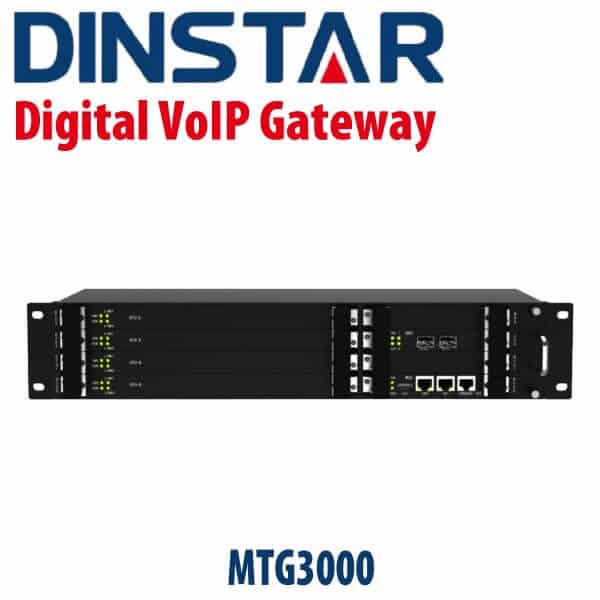
The Dinstar MTG3000 is built for that layer. It sits between E1/T1 or STM-1 digital trunks and an IP voice network, converting legacy carrier or PABX signalling into SIP. For Dubai operators, ISPs, large enterprises, hotel groups, banking branch networks, and system integrators handling old PRI estates, it gives a way to move trunks without forcing a full rip-and-replace on day one.
What the MTG3000 is
The Dinstar MTG3000 is a high-density digital VoIP gateway for E1/T1 and STM-1 trunk conversion. On the circuit side, it supports 16 to 63 E1/T1 ports and STM-1 interface. On the IP side, it provides SIP trunking over dual gigabit network ports. Between the two, it handles the signalling and media conversion needed when a legacy PRI, SS7, or R2 trunk environment has to talk to an IP voice core.
That makes it different from an analog gateway. A DAG gateway deals with FXS or FXO ports for analog devices and copper lines. The MTG3000 deals with digital trunks: E1, T1, PRI, SS7, R2, SIP-T, and high-volume call routing. It belongs in carrier rooms, ISP voice nodes, enterprise core PABX rooms, and multi-site migration projects where the question is not “how many phones?” but “how many channels must survive the cutover?”
For a Dubai project, that usually means one of three scenarios: an existing PABX estate with PRI trunks moving toward SIP, an operator interconnect between legacy TDM and IP networks, or a large branch network where E1 circuits still carry voice traffic and must be brought into a newer SIP platform in phases.
E1 arithmetic — the sizing detail that decides the model
An E1 is not just “one line”. In voice projects, one E1 carries 30 voice channels. That means one E1 can carry up to 30 simultaneous calls. Two E1s give 60 channels. Ten E1s give 300 channels. The maths is simple, but this is where many project quotes become unclear.
The MTG3000 scales from 16 to 63 E1/T1 ports. On E1, the top-end calculation is 63 × 30 channels, which gives up to 1890 simultaneous calls. That is why the MTG3000 sits above smaller Dinstar MTG models. It is not for a branch with one or two PRI links. It is for aggregation: many E1s, carrier-side routing, operator interconnect, or a large enterprise trunk layer that needs headroom.
The 60-second sizing check
Count the active E1s first, not the number of extensions. Multiply E1 count by 30 to estimate maximum voice channels. Then check signalling type — PRI, SS7, or R2 — and whether the project needs STM-1. If you are between model tiers, send us the trunk count, signalling type, and target SIP platform on WhatsApp and we confirm the right model.
For T1 projects, the arithmetic changes because a T1 PRI normally carries 23 bearer channels plus signalling. Most UAE and MEA digital trunk work we see is E1-based, but export projects can involve T1 depending on the operator network. This is why the quote should always state the trunk type, number of circuits, signalling method, and expected concurrent calls.
Do not size this gateway by extension count alone. A 4,000-extension hospitality group may only need a few hundred trunk channels. A carrier interconnect with fewer end users may need far more concurrent call capacity. MTG sizing is about trunk channels, call paths, and signalling design.
Built for PRI, SS7, R2, and SIP-T migration
The MTG3000 supports ISDN PRI, SS7, and R2 MFC on the digital side, with SIP v2.0, SIP-T, UDP, TCP, and TLS on the IP side. That matters because not every old trunk behaves the same way. A PRI migration from an enterprise PABX is different from an SS7 operator interconnect. R2 still appears in some export and carrier environments. SIP-T matters when signalling information has to be carried cleanly across the IP side during interconnect work.
In practical terms, the gateway lets the existing digital trunk world keep speaking its language while the new network speaks SIP. The Dubai integrator does not have to persuade every stakeholder to change at once. The old PABX can stay during phase one. The SIP platform can be introduced. Routes can be moved in blocks. Call testing can be done trunk by trunk. The risky part becomes controlled.
This is the main project value: the MTG3000 buys time. It lets a service provider, hotel group, bank, or enterprise move from TDM to SIP without forcing one hard cutover across every site and every trunk. For Etisalat and du SIP projects, that staged method is often the difference between a clean migration and a weekend full of failed calls.
Where the MTG3000 fits in Dubai projects
In Dubai, the MTG3000 is usually not bought as a single box. It is bought as part of a trunk design. One project may involve an old hotel PABX with multiple PRI links and hundreds of room phones. Another may be an ISP voice node that needs SS7 on one side and SIP interconnect on the other. A third may be a free zone enterprise with a central PABX, branch routing, and a slow migration to SIP trunks.
That is why staging matters before dispatch. We do not treat the MTG3000 as a warehouse item moving from shelf to site. The trunk plan, SIP peer, routing rules, prefixes, caller and called number manipulation, codec plan, fax behaviour, and management access all need to be agreed before the unit is powered on in the rack.
Vector Digital Systems supplies the Dinstar MTG3000 from Dubai for project quantities, operator deployments, and MEA export. The buyer is usually a system integrator, PABX contractor, ISP, operator team, or IT company delivering a larger voice migration. The work is technical from the first call. Good. That is exactly where this model belongs.
The difference between “ports” and “calls”
A port is the physical trunk interface. A call is a live voice path. With E1, each port can carry 30 voice channels. So a project with 20 E1s is not a “20-call” project. It is potentially a 600-call trunk layer. That distinction has to be clear in the purchase order, the rack plan, and the commissioning sheet.
The MTG3000 is published for up to 1890 simultaneous calls at full E1 scale. But the quoted unit must still match the project configuration: number of E1/T1 ports, STM-1 requirement, signalling type, redundancy requirement, and any channel activation terms included in the commercial quote.
Channel activation must be confirmed in the quote
The MTG3000 supports high-density E1/T1 capacity, but project quotes should state exactly what the supplied unit includes: port count, active channels, signalling requirement, and any activation items. We confirm this before procurement so the integrator does not discover a missing capacity item during commissioning.
This is the reason we ask for trunk details before quoting. A clean MTG3000 quote is not just “one gateway”. It should describe the real trunk count, the enabled capacity, the site role, and the staging scope. Project buyers in Dubai, Abu Dhabi, Sharjah, and export markets need that clarity for approval and handover.
Why the MTG3000 is not the first MTG model for every job
If the project has a small PRI estate, the MTG3000 may be too large. Dinstar has smaller MTG models for lower E1 counts. The MTG3000 earns its place when the trunk count climbs, when STM-1 is part of the design, when SS7/R2 interconnect is required, or when the buyer wants a carrier-grade 2U chassis with power and control redundancy.
For a single-site PABX with a few E1s, we normally review the Dinstar MTG2000 first. For operator-scale interconnect beyond this tier, the Dinstar MTG5000 becomes the next discussion. For buyers still deciding between analog FXS/FXO gateways, E1 gateways, and wireless gateway options, start with the VoIP gateway selector.
The MTG3000 sits in the middle of that decision path: too large for a small branch, right for high-density E1/T1 migration, and practical for operators and large enterprises that still have serious TDM voice traffic to carry into a SIP future.
Deployment truth: rack, power, network, and management
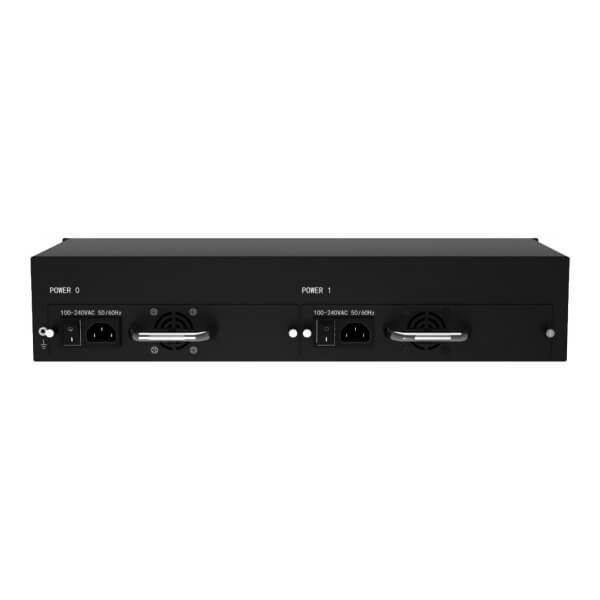
The Dinstar MTG3000 is a 2U digital trunk gateway for the main rack, not a side-wall appliance. It belongs in the voice core, near the E1/T1 handoff, SDH equipment, carrier demarcation, or central PABX room. The chassis uses dual gigabit Ethernet ports for the IP side and redundant power supply design for projects where a trunk node cannot be treated as a single-point convenience item.
For Dubai operator rooms, ISP voice nodes, and large enterprise comms rooms, the physical plan matters before the box arrives: E1 patching, STM-1 requirement, earthing, rack position, power source, IP addressing, SIP peer reachability, and management access. We confirm those details during staging so the site team is not solving trunk design at the rack door.
Management is also part of the project. The MTG3000 supports web management, SNMP, configuration backup and restore, network capture, syslog, call history records, and Dinstar cloud management. For multi-site or operator deployments, that means the gateway can be enrolled and monitored as part of a fleet, not left as an unknown device with one saved password on one engineer’s laptop.
Staging before dispatch: SIP peer registration or trunk profile, route plan, prefix rules, caller and called number manipulation, codec plan, fax behaviour, management access, and basic call testing are prepared before dispatch. For project batches, we label and document each unit against the site role.
Current capability set worth checking before older quotes are reused
A lot of MTG3000 quotations are copied from old operator templates. That is risky. This model should be specified by the current requirement: E1 or T1 count, STM-1 need, PRI or SS7 or R2 signalling, SIP-T requirement, redundancy design, codec plan, fax handling, and management method. If a tender only says “PRI gateway”, it is not enough for a clean supply.
The capability set we check during procurement includes SIP over UDP, TCP, and TLS, SIP-T interconnect, ISDN PRI, SS7, R2 MFC, T.38 and pass-through fax, NAT support, flexible routing, access rules, black and white lists, IP trunk priority, and number manipulation. These are the parts that decide whether the gateway will actually fit the operator or enterprise voice design.
Do not reuse an old MTG3000 quote without checking activation
The commercial quote must state the supplied configuration: E1/T1 port count, active channel requirement, STM-1 requirement, signalling type, and any activation items. We confirm this in the same quote so the project team does not discover a missing capacity item during commissioning.
Platform compatibility in Dubai trunk projects
The MTG3000 is normally deployed between legacy digital trunks and SIP platforms. On enterprise jobs, that may be an existing PABX moving toward 3CX, Grandstream UCM, Yeastar, Asterisk, Cisco, or another SIP voice core. On operator jobs, it may be a SIP interconnect facing an upstream or downstream carrier. The useful question is not only “is SIP supported?” It is “what signalling must be preserved, what routes must be translated, and what call patterns must pass on day one?”
For Etisalat and du business voice projects, we stage the SIP side around the approved service design and the customer’s PABX or carrier platform. Prefixes, outbound routing, inbound DID handling, codec order, fax policy, and failover behaviour need to be written down before cutover. Good trunk work is boring at go-live because the hard questions were handled earlier.
For buyers still deciding whether they need an E1 gateway, an analog FXS/FXO gateway, or an SBC in front of the SIP trunk, use the VoIP gateway selector first. If the project is already at carrier or high-density PRI scale, the MTG3000 discussion starts with trunk count and signalling.
MTG2000, MTG3000, MTG3000T, or MTG5000 — choosing inside the Dinstar range
| Model | Where it fits | Choose it if… |
|---|---|---|
| Dinstar MTG2000 | Lower E1-count digital trunk migration | The site has a smaller PRI estate and does not need MTG3000 scale. |
| Dinstar MTG3000 — this unit | High-density E1/T1 and STM-1 trunk conversion | The project needs 16 to 63 E1/T1 ports, up to 1890 calls, PRI, SS7, R2, or SIP-T. |
| Dinstar MTG3000T | Lateral MTG3000-family option for transcoding-led designs | The gateway role includes heavy media conversion as a core requirement. |
| Dinstar MTG5000 | Larger operator-class core gateway projects | The MTG3000 tier is not enough for the operator design or future capacity plan. |
Choose the MTG2000 if the PRI estate is smaller and the project does not need MTG3000 scale. Choose the MTG3000 when the work is high-density E1/T1, STM-1, PRI, SS7, or R2 migration with up to 1890 calls. Choose the MTG3000T when transcoding is the deciding point. Choose the MTG5000 when the operator core design has outgrown this tier.
Pricing, supply, and staging from Dubai
Vector Digital Systems supplies the Dinstar MTG3000 from Dubai for operators, ISPs, system integrators, PABX installers, large enterprises, and export projects. We quote in AED for UAE supply, with VAT breakdown, delivery, configuration scope, and project quantities stated clearly. No fixed web price, because an MTG3000 quote depends on the real trunk configuration.
For procurement teams, we can prepare a formal quotation with model, configuration, warranty, commercial terms, and staging scope. For integrators, send the E1/T1 count, signalling type, destination platform, site location, and cutover target. We will return the correct Dinstar model tier, not just the biggest one.
Frequently asked questions
How many simultaneous calls does the Dinstar MTG3000 handle?
The Dinstar MTG3000 supports up to 1890 simultaneous calls at full E1 scale. One E1 carries 30 voice channels, so the final call count depends on the number of active E1 ports and the supplied project configuration.
Does the MTG3000 support PRI, SS7, and R2?
Yes. The MTG3000 supports ISDN PRI, SS7, and R2 MFC on the digital trunk side, with SIP and SIP-T on the IP side. We confirm the required signalling type before quotation and staging.
Will the MTG3000 work with our 3CX, Grandstream UCM, Yeastar, or existing PABX?
Yes, where the project design is SIP-based and the trunk signalling is correctly mapped. The MTG3000 can sit between E1/T1 digital trunks and SIP platforms such as 3CX, Grandstream UCM, Yeastar, Asterisk, Cisco, and existing PABX environments. We stage the SIP peer, route plan, and number manipulation before delivery.
Can we keep our old PABX and still move to SIP trunks?
Yes. That is one of the main MTG3000 uses. The gateway lets the existing PRI, SS7, or R2 trunk side remain in service while the IP side connects to a SIP voice network. Routes can then be moved in phases instead of forcing one hard cutover.
MTG3000 vs MTG2000 — what is the difference?
The MTG2000 fits smaller digital trunk projects. The MTG3000 is the higher-density tier for 16 to 63 E1/T1 ports, STM-1 interface, and up to 1890 simultaneous calls. We choose between them by trunk count, signalling type, growth plan, and redundancy requirement.
Does Vector Digital Systems configure the MTG3000 before delivery?
Yes. Staging can include SIP peer setup, route rules, prefix handling, caller and called number manipulation, codec plan, fax behaviour, management access, and test calls before dispatch. Multi-site or operator projects are documented site by site.
Is VoIP legal in the UAE and can this be used with Etisalat or du?
Business VoIP through licensed operators is the normal UAE route under TRA regulation. The MTG3000 is used for lawful business SIP, PRI, and operator interconnect projects with Etisalat, du, authorised service designs, and approved enterprise voice systems.
Is the Dinstar MTG3000 covered under Dinstar warranty in the UAE?
Yes. Vector Digital Systems supplies the MTG3000 with Dinstar manufacturer warranty, UAE support handling, and documentation for project procurement and handover.
Who is the supplier of Dinstar MTG3000 in Dubai?
Vector Digital Systems LLC is an authorised Dinstar supplier in Dubai, UAE, operating since 2009. We supply Dinstar MTG digital gateways with staging, configuration, installation across all seven emirates, export documentation, and warranty handling for project buyers.
What is the best E1 gateway for high-density trunk migration in Dubai?
For high-density E1/T1 migration, operator interconnect, SS7 or PRI conversion, and up to 1890 simultaneous calls, the Dinstar MTG3000 is the right Dinstar tier. Smaller PRI estates may suit the MTG2000; larger operator core projects should be checked against the MTG5000.
Does Vector Digital Systems export Dinstar MTG3000 from Dubai?
Yes. We export Dinstar MTG gateways from Dubai to telecom operators, ISPs, system integrators, and PABX contractors in Saudi Arabia, Oman, Qatar, Iraq, Kenya, Tanzania, Ghana, Nigeria, Pakistan, and Kazakhstan. FOB Dubai pricing is available with commercial invoice, packing list, certificate of origin, and Dinstar manufacturer warranty.
Supply and installation across all seven UAE emirates
Vector Digital Systems supplies and installs Dinstar MTG3000 gateways across Dubai, Abu Dhabi, Sharjah, Ajman, Ras Al Khaimah, Fujairah, and Umm Al Quwain. We also support free zone and enterprise projects in DMCC, JAFZA, Dubai Internet City, DIFC, Abu Dhabi industrial zones, and multi-branch UAE networks where trunk cutover needs one staging plan.
MEA export from Dubai
For export projects, the MTG3000 is normally quoted for operators, ISPs, voice service providers, system integrators, and PABX contractors handling E1/T1 migration or interconnect work. Vector Digital Systems supplies FOB Dubai with export documentation including commercial invoice, packing list, and certificate of origin. Regular export lanes include Gulf, East Africa, West Africa, South Asia, and Central Asia, with Dinstar manufacturer warranty included in the project quote.
About Vector Digital Systems — authorised Dinstar supplier in Dubai
Vector Digital Systems LLC supplies the Dinstar MTG3000 from Dubai, UAE, with staging, configuration, and installation across all 7 UAE emirates — Dubai, Abu Dhabi, Sharjah, Ajman, Ras Al Khaimah, Fujairah, and Umm Al Quwain — and export across the Middle East and Africa with FOB Dubai pricing. Operating since 2009. Contact: sales@vectordigitals.net · Monday–Saturday 8AM–6PM.
Get a quote for Dinstar MTG3000
Dubai supply · AED quote · Staged before dispatch · Project quantities and export
