Description
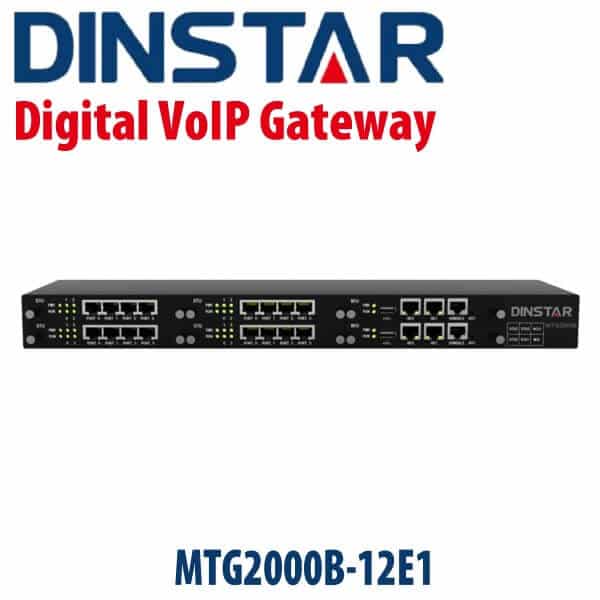
Dinstar MTG2000B-12E1 12 E1 High-Availability Digital VoIP Gateway Dubai
The SIP trunk contract is ready. The new platform is ready. Then the site survey finds the real project: twelve live E1 circuits feeding an old PABX, a call-centre dial plan that cannot go down, PRI numbers already printed on customer forms, and a carrier handover that still speaks the language of traditional trunks. This is the point where a normal SIP migration becomes an E1 migration.
The Dinstar MTG2000B-12E1 is built for that middle ground: enough E1 capacity for serious operator, service provider, call-centre, and large enterprise projects, without jumping straight into a higher-density chassis. It keeps the existing E1 side alive while the IP side talks SIP to the new voice core, hosted platform, IMS network, or customer PABX.
For Dubai projects, that matters. Many sites are not starting fresh. They have Etisalat or du trunk history, legacy PRI routing, number ranges, hunt groups, fax traffic, POS devices, and old PABX programming that cannot simply be thrown away. The MTG2000B-12E1 gives the integrator a clean bridge: twelve E1 ports on one side, SIP trunking on the other, with high-availability hardware for sites where trunk downtime becomes a business problem within minutes.
What the MTG2000B-12E1 is
The Dinstar MTG2000B-12E1 is a high-availability digital VoIP gateway from the MTG2000B family. It connects traditional E1/T1 networks to SIP networks. On the TDM side, it supports ISDN PRI, SS7, and R2 MFC signalling. On the IP side, it supports SIP v2.0, multiple SIP trunks, flexible routing, and mainstream VoIP platform interconnection.
The 12E1 wording is important. This is not a different replacement product. It is the twelve-E1 configuration of the MTG2000B platform. The MTG2000B family scales from 4 to 16 E1/T1 ports in a 1U chassis; the 12E1 build is selected when the project needs twelve PRI or SS7 spans, not eight and not the full sixteen.
Typical buyers are telecom operators, ISPs, call centres, hosted voice providers, system integrators, and PABX installers moving old trunk infrastructure into an IP network. In a Dubai call-centre project, that might mean keeping the existing PRI handover from Etisalat while the call platform moves to SIP. In a service provider project, it might mean interconnecting a PSTN-facing switch with a SIP softswitch. In a hotel or corporate tower, it can be the bridge between an old E1 PABX estate and a new IP core.
Vector Digital Systems stages this gateway before dispatch from Dubai: SIP trunk settings, E1 mode, clocking direction, routing tables, number manipulation, fax behaviour, and management access are prepared before the unit reaches site. That saves the installer from doing first-time trunk work in a live comms room.
E1 arithmetic: why 12E1 means 360 voice channels
E1 gateway sizing is simpler than it looks once the arithmetic is clear. One E1 carries 30 usable voice channels. Two E1s carry 60. Four E1s carry 120. Eight E1s carry 240. Twelve E1s carry 360. Sixteen E1s carry 480.
Sizing rule for MTG projects
Count the active E1 spans first, then multiply by 30 channels. A 12E1 project gives 360 E1 voice channels when all twelve spans are active and provisioned. The final usable call capacity still depends on carrier provisioning, signalling design, SIP-side limits, and any channel activation included in the quotation. Send us your requirement on WhatsApp and we confirm the right model.
That last line matters because project buyers often ask, “How many simultaneous calls does it handle?” For this configuration, the plain E1-side answer is 360 voice channels across twelve E1s. The wider MTG2000B family is listed for up to 480 simultaneous calls at the sixteen-E1 level. For a 12E1 order, the quote should state clearly whether all twelve E1 ports and channels are included and what the carrier or platform side is expected to provide.
This is why we do not treat MTG gateways like small desktop boxes. A 12E1 gateway sits in the middle of a trunk design. The installer must know the signalling type, clock source, number format, incoming and outgoing routing, whether fax or POS traffic exists, whether SS7 links need redundancy, and whether the SIP side is a PABX, softswitch, SBC, or operator IMS platform.
When the site is in Dubai, Abu Dhabi, Sharjah, or a free zone such as JAFZA, DMCC, or Dubai Internet City, this is often tied to a phased migration. The old PABX may stay live for a month while the SIP platform takes over department by department. The MTG2000B-12E1 gives the project team enough E1 capacity to run that phase without forcing a full chassis jump.
Why the “B” version matters on a trunk project
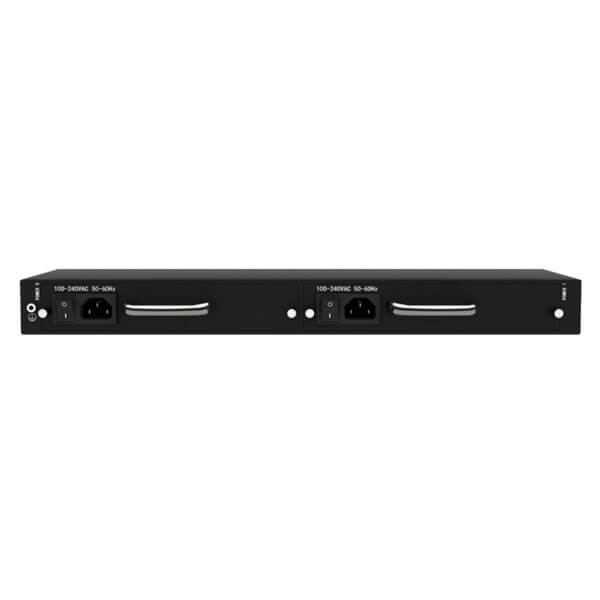
The MTG2000B is the high-availability version in the MTG2000 family. It is designed with redundant main control units and dual power supplies. For a branch gateway with one or two trunks, that may sound like an extra. For a twelve-E1 trunk gateway, it is the difference between a tidy migration and a painful outage conversation.
A 12E1 deployment can sit in front of a call centre, service provider interconnect, hotel operator room, or multi-tenant voice platform. If that gateway fails, hundreds of active channels can be affected. Redundant MCU design and dual power inputs are there because this class of gateway is normally placed in a rack where uptime matters: telecom rooms, ISP nodes, data centres, and corporate head offices.
The 1U chassis also keeps the rack plan clean. Twelve E1s in separate small devices create cabling, clocking, support, and routing headaches. One MTG2000B-12E1 gives the project team a single management point, one SIP routing plan, one gateway policy, and one monitored device. That is easier for a Dubai integrator to support after handover, and easier for the customer’s IT team to understand.
Channel activation must be written into the quote
Do not buy an E1 gateway from a model name alone. For MTG projects, the quote must state the exact E1 port count, channel activation, power option, and signalling requirement. We quote the MTG2000B-12E1 as a twelve-E1 project unit and confirm the included activation before supply.
PRI, SS7, R2 MFC, SIP — the gateway speaks both sides
The reason MTG gateways survive in modern projects is that many networks do not move in one clean jump. The old side may be ISDN PRI from a carrier, SS7 from an operator interconnect, or R2 MFC in a legacy network. The new side may be a SIP trunk into a softswitch, a hosted PABX platform, an SBC, or a SIP-capable enterprise PABX.
The MTG2000B is designed for that translation layer. It supports ISDN PRI, SS7 including SS7 link redundancy, and R2 MFC on the traditional side, with SIP v2.0 and multiple SIP trunks on the IP side. It also supports T.38 and pass-through fax, which matters in UAE deployments where fax has not fully disappeared from trading companies, clinics, logistics offices, and government-facing workflows.
Modem and POS support also earns its place in this model. Some projects still carry card machines, legacy telemetry, or data devices that were never designed for a pure VoIP world. The correct answer is not to promise that every old device will behave perfectly over IP. The correct answer is to identify those devices during staging, select the right codec and pass-through behaviour, then test before dispatch.
For integrators, this is where Vector Digital Systems adds value beyond box supply. We ask what the E1s connect to, what the SIP side is, how numbers should be presented, whether the carrier expects national or international format, what clocking is required, and how failover should behave. Then we prepare the gateway so site work becomes cabling, verification, and final acceptance — not guesswork under pressure.
Where the MTG2000B-12E1 fits in Dubai projects
Choose the MTG2000B-12E1 when the site already has a serious E1 footprint. Twelve E1s is more than a small PABX migration. It usually means a call centre, operator-facing platform, multi-branch voice hub, large hospitality site, or service provider interconnect. At this level, the buying decision is not only “does it have enough ports?” It is also “can we stage it, document it, monitor it, and support it after go-live?”
A Dubai system integrator might use it to retain an old PRI estate while migrating users to a new SIP PABX. A service provider may place it between a PSTN-facing E1 network and a SIP voice platform. A bank or large enterprise may use it in a trunk consolidation project where old E1 circuits from several branches are brought into a central IP voice core.
The gateway selector for smaller analog needs is different: analog devices need FXS gateways, analog lines need FXO gateways, and old PABX E1 trunks need MTG. If the project starts with mixed requirements, use the VoIP gateway selector first, then size the MTG layer once the E1 count is confirmed.