

One venue. Sometimes two rooms.
The AV follows the wall — automatically. All 7 emirates.
Banquet halls, training centres and boardroom pairs with an operable wall: two independent meeting systems when divided, one seamless large room when combined — with the partition itself telling the equipment which mode to be in. Vector Digital Systems designs it, installs it, and proves it with live calls in both modes before handover. Since 2009, from Dubai stock.
"A venue that never depends on anything it doesn't control — and never turns away anything it can serve."
- Paired room systems — Teams Rooms or Zoom Rooms
- Partition sensors wired to the AV processors
- Merge logic with one-touch mode change
- Per-zone ceiling microphone & speaker arrays
- Cameras counted per zone, directed when combined
- Control panel presets for divided and combined
The morning the wall was open and both rooms joined the same call
Every venue with an operable wall has lived a version of this. Tuesday: the wall is closed, two trainings run side by side, and the microphones in Room B keep picking up the trainer in Room A through the partition seam. Thursday: the wall is open for the quarterly townhall, someone starts the video call from Room A's system — and Room B's cameras, screens and microphones sit dark, because they belong to a different system that has no idea the wall moved.
The equipment is not broken. It was simply never designed around the one thing that defines this venue: the wall moves, and the AV has to know. A divisible room is not a large room with a partition. It is two rooms and one room, on different days, and the systems inside it need an architecture built for both states — plus a reliable way to detect which state they are in right now.
This page is that architecture, written out: the decision that sets the budget, the three ways to build it, the sensor wiring, the licence line item that surprises everyone, and the audio physics that decide whether the combined room sounds like one space or an argument between two.
One question decides half the budget — answer it before anyone quotes
When the wall is closed, do both rooms need to host their own video meetings at the same time?
Everything follows from this. If the answer is no — the divided rooms are used for local sessions, and video calls only ever happen from one side or in combined mode — then one properly designed system with two operating presets covers the venue. One set of platform licences, one processor, roughly half the electronics. Many venues honestly belong here, and a supplier who asks this question before quoting is saving you real money.
If the answer is yes — a Teams call in Room A while Room B hosts its own Zoom training — then the venue needs two complete, independent room systems that can merge into one when the wall opens. Two processors, two camera sets, two licences, plus the merge layer between them. It costs roughly double the single-system design, and no configuration trick avoids it: simultaneous independent meetings require independent systems, by definition.
The honest failure mode we see in quotations: a single-system price presented for a both-rooms-simultaneously requirement. It demos perfectly with the wall open, and fails on the first Tuesday two bookings collide. Answer the question first. Then read the three architectures below knowing which half of the page is yours.

The three divisible-room architectures — and what each honestly costs
Architecture 1 — Paired native rooms with a merge layer (AED 120,000–260,000+). Two complete Microsoft Teams Rooms or Zoom Rooms, linked by the manufacturer's official divisible-room mode. Each side has its own compute, controller, cameras and audio. Divided: two fully independent rooms, one-touch join on each side. Combined: one system becomes the controlling room, the other's cameras, microphones and displays join it, and the whole venue behaves as a single native room. Current modular ecosystems support this across two to four combinable spaces. This is the corporate standard: simultaneous independent meetings when divided, full one-touch simplicity in every mode, and the platform's own intelligent framing directing all cameras when combined. It carries the two-licence line item explained below — budget it from day one.
Architecture 2 — AI matrix-tracking core (AED 60,000–140,000). A central 4K matrix tracking processor — the class AVer's new MT500 defines — takes every camera in the venue and auto-switches between them with AI voice tracking. The directed feed goes to whichever meeting PC the current mode requires. Dante and NDI carry audio and video over the network. GPIO accepts the partition sensor directly. Divided: each zone's devices route to that zone's PC. Combined: the full camera set feeds one call as an automatically directed multi-camera production. Platform-flexible by nature — Teams today, Zoom tomorrow, a guest's laptop on Saturday — which is exactly why venues, training providers and government chambers choose it. The trade: it is a production architecture, not a native room; one-touch platform integration is lighter than Architecture 1.
Architecture 3 — USB matrix switching (AED 28,000–60,000). A USB matrix routes each zone's cameras and speakerphone system to the right PC per mode, recalled as presets from a control panel. Honest and effective at its tier — with two truths stated plainly. First, a video call uses one camera at a time, so combined mode gives you selectable cameras, not automatic multi-camera direction; that is the feature you are not paying for. Second, combined-mode audio must be designed as one chained system covering the whole space — never two independent speakerphone hubs routed to a single PC, which leaves the call using one and ignoring the other. Right for budget-conscious venues where combined-mode meetings are occasional and simple.
These are supply-and-installation ranges for typical two-room venues; partition works, displays and ceiling scope move them, and a survey converts them into a fixed quotation. Whichever architecture fits, one Vector rule applies to all three: handover means live test calls in divided mode and combined mode, with you in the room for both.
Why two divisible-room quotes can be 80,000 dirhams apart
Divisible quotes diverge harder than any other room type. The reason is simple. Half the cost hides in things that never appear on a brochure.
Five line items move a divisible price. The merge layer itself — processors, sensor works and mode programming — which some quotes include and some quietly assume away. Cross-zone containment: cable routes between rooms cost real ceiling work, and a quote that never mentions containment has not planned it. DSP sizing: enough echo-cancelled channels for the combined microphone count, not one zone's worth — the single most common undersizing. The recurring platform licences, disclosed or buried. And commissioning time: a both-modes handover with staged wireless validation takes days, not hours, and quotes priced on hours are telling you what they intend to skip.
What Vector puts in writing before you sign: equipment at quoted price. Cross-zone cabling and containment included and drawn. DSP channel count stated against the combined microphone count. Licence lines shown separately — included, excluded, or not applicable. Both-mode commissioning as a fixed deliverable. Put any comparison quote against this list. The missing 80,000 dirhams is usually sitting between the ceiling and the licence renewal, waiting to reappear as a variation order.
How the wall tells the system: partition sensors and mode logic
Asking staff to remember a mode switch is how divisible rooms fail in month two. The professional design removes the human step: a partition sensor detects the wall's state, and the detection drives the mode change. Current room ecosystems make this native. Yealink's room sensor family feeds partition state to the AV processor's GPIO — open recalls the combined preset, closed recalls the divided one. MT500-class cores accept the same contact on their own GPIO. And any of the three architectures can take a hard-wired contact from the partition track itself — the most reliable signal of all, when the wall installer provides it.
One field lesson from a recent Dubai venue deployment, worth the paragraph it costs: define what "open" means before commissioning. Operable walls can stack half-way — a passage opened between rooms while most of the partition stays closed. Half-open is combined for sound and divided for cameras: audio bleeds through the gap while each camera set still faces its own zone. The design answer is to treat the sensor states strictly — fully closed is divided, fully open is combined, and anything between is defined in advance (ours defaults to divided, with a control-panel override). A venue that skips this conversation discovers it during a live event.
The two-licence truth nobody puts on page one of a quote
If both halves host their own native Teams or Zoom meetings when divided, each half is a room in the platform's eyes — its own resource account, its own calendar, its own annual room licence. Two rooms, two licences, every year. It is not a Vector charge and not optional; it is how Microsoft Teams Rooms and Zoom Rooms are licensed, and it applies to Architecture 1 by definition.
We state it here because it is the most common surprise in divisible-room budgets — quoted systems that match to the dirham, separated only by whether this recurring line was disclosed. Architecture 2 and 3 venues running BYOD carry no room licences at all, which is part of their price story. Whatever you choose, the licence position is written into our quotation explicitly — included, excluded, or not applicable — so the comparison you make is real.
Audio across the divide: the physics that make or break combined mode
Video failures in divisible rooms are visible and get fixed. Audio failures get lived with — so audio is where the engineering earns its fee. Three rules govern it.
Each zone gets its own ceiling coverage, echo-cancelled in its own right. Ceiling microphone and speaker arrays are laid out per zone with the coverage-radius arithmetic any large room uses — and the DSP behind them must carry echo-cancelled channels for every microphone in the combined count, not just one zone's worth. Combined mode is the stress test: double the microphones, one shared acoustic space, and an undersized processor announces itself in the first ten minutes.
New conferencing audio stays fully separate from any existing building PA. A recent Dubai venue arrived with exactly this fault: legacy PA speakers and new conferencing audio overlapping in the same ceiling zones, producing an echo that no processing setting could remove — because two systems were fighting in the same air. The fix is architectural, not digital: the zones are mapped in the survey and one system owns each.
Presenters' wireless microphones must be validated against the ceiling arrays — on site, during staging. Townhall and banquet use means handhelds. Licensed-band professional wireless coexists with ceiling pickup, but the combination is proven in the actual room before event day, never assumed from datasheets. Systems from the Shure wireless families are our standard companions here for exactly this reason.
Cameras across the divide
Camera count is decided the same way as any large room — one camera position per zone that matters, placed by the 8-to-10-metre reach rules explained on our large meeting rooms page — with one divisible-specific layer on top: every camera must make sense in both modes. Divided, each zone's cameras serve that zone's call. Combined, the full set feeds one call, with direction handled by the platform's intelligent framing in Architecture 1 or the AI tracking core in Architecture 2.
The wiring lesson that must precede containment: in modular native ecosystems, cameras connect to their AV processor over dedicated point-to-point links on Cat6 — the manufacturer's own transport, not ordinary LAN traffic. In a divisible venue those runs cross zones to reach the controlling processor in combined mode, which means the cable routes are a design decision made with the floor plan, not an afterthought once the ceiling is closed. It is one of the first things our survey draws.
Displays that make sense divided — and combined
Divided mode is easy: each zone runs its own display pair, sized from that zone's farthest seat. Combined mode is where display design gets tested. The venue doubles in depth. The far zone's seats are now twenty metres from the primary screens. Nobody in row twelve should be squinting at a spreadsheet.
The working answer: in combined mode, the far zone's displays become repeaters. Content mirrors to them. Remote participants appear on them. The back half of the venue watches its own screens while the front half watches the primary pair — one meeting, two viewing distances, both served. This routing is part of the merge preset, not an operator task. Where the combined depth passes what panels can carry, the venue moves to direct-view LED at the primary end, sized from the true back row.
Content entry follows the same both-modes rule. Each zone keeps its own sharing path for divided use. Combined mode adds one clean lectern input — wired HDMI or wireless — that feeds every screen in the house. One honest exclusion, stated as always: we size displays from the measured back row of the combined room, and we show the working. Inches the last row cannot justify are not on our quote.
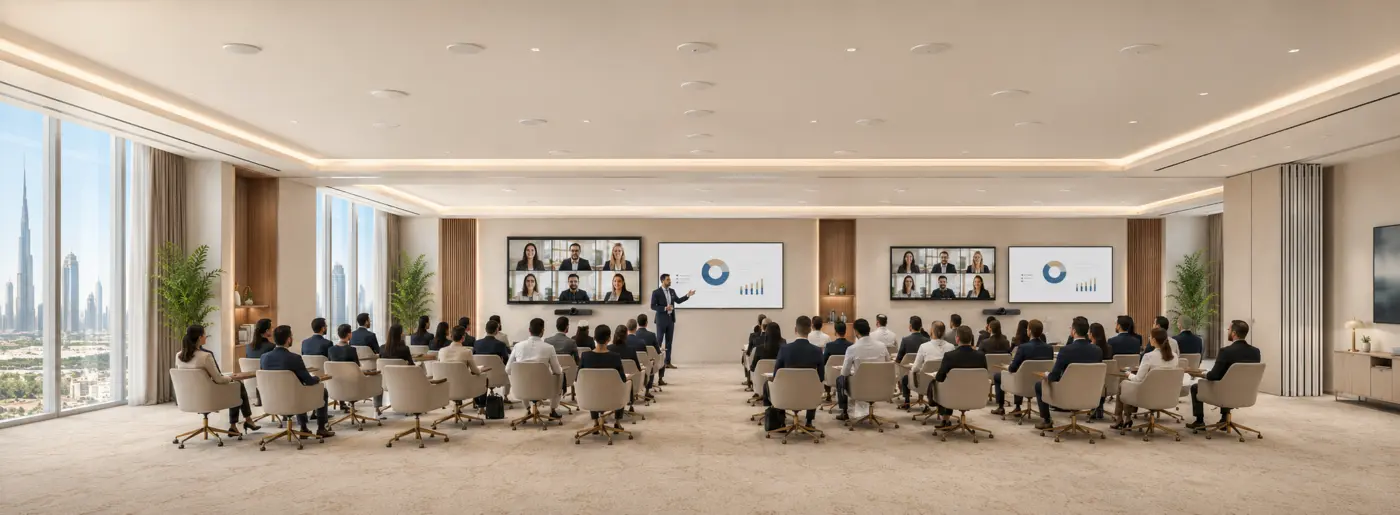
The venues that divide — and how each is designed
Hotel banquet and conference halls. The commercial heart of divisible AV in Dubai: one ballroom sold as two, three, sometimes four spaces. Revenue depends on every configuration working without an AV technician on standby — which is why sensor-driven presets and both-mode testing were invented for exactly this venue. BYOD paths matter here too: the client organisation brings its own platform.
Training centres. Two classrooms Monday to Thursday, one seminar hall on launch day. Usually the clearest case for answering the budget question honestly — many centres never run simultaneous video sessions and are perfectly served by Architecture 2 or a single-system design, and we will say so.
Corporate boardroom pairs. Two boardrooms with an operable wall for the monthly all-hands. The strongest case for Architecture 1: native one-touch Teams in both rooms daily, full merge for the townhall, the platform experience identical in every mode.
Government and majlis halls. Formality, handheld microphones, recording requirements and platform flexibility — the profile the AI tracking-core architecture serves best, with Dante audio and NDI outputs feeding recording and overflow rooms natively.
Platforms in a divisible venue: native both sides, or bring-your-own
Corporate pairs standardise native: Teams Rooms or Zoom Rooms on both sides, two licences, one-touch in every mode, and interoperability guest-join for the odd external platform. Venues hosting outside organisations flip the logic: the organiser's laptop is the platform, so the design centres on a clean BYOD path — one cable at the lectern driving the whole combined room's cameras and audio — with USB extension engineered for the distances a merged venue creates. Many installations run both: native for the house, BYOD for guests. The decision is made in the survey conversation, not discovered at the first booking.
The booking problem nobody warns you about — and the IT handover
Here is the question that surfaces in week one, not in any brochure: how do people book the combined room in Outlook? The platform sees two rooms. Two resource accounts, two calendars. There is no native third calendar called "the big room."
The working designs, honestly compared. Simplest: the combined event books both rooms — the organiser invites Room A and Room B, both calendars block, and a one-line booking policy tells staff this is the rule. Most venues live happily here. Larger operations add a coordinator rule: combined bookings go through facilities, who block both calendars and schedule the wall move. What we advise against is inventing a third phantom resource account for the combined state — it double-books against reality and breaks the sensor-driven logic the room depends on. The right answer is policy plus training, not a third calendar, and it is part of our staff handover.
The rest of the IT handover mirrors any serious large room, doubled: a wired network drop per zone, PoE budgets calculated for each zone's cameras and ceiling arrays, two resource accounts enrolled with clean naming — Room A, Room B, and a naming note that tells every organiser they combine — and remote device management enabled on both systems from day one. At handover you receive both zones' port maps, the cable schedule including the cross-zone runs, the sensor wiring record and the preset logic in writing. The engineer who inherits this room in three years will find everything. That sentence is on the page because you have inherited the opposite.
Who presses what: control and daily operation
A divisible room succeeds when the Tuesday-morning coordinator — not an engineer — can run it. The operating design: mode changes happen automatically from the partition sensor, with a control panel holding the same presets for manual override and the defined partial-opening state. In combined mode under Architecture 1, one room's controller becomes the venue's controller — the control-room concept — while the second controller stands down cleanly rather than fighting for the call. Staff handover at commissioning covers exactly three things people actually do: start a meeting divided, start a meeting combined, and recover when someone moved the wall mid-call. Everything else is the system's job.
What the divisible survey measures — beyond the standard large-room list
Everything on the large-room survey checklist applies — depth, ceiling, glass, HVAC, containment, existing PA zones — plus the layer only divisible venues have. The wall itself: partition type, stacking direction and pocket location, whether the track can carry a hard-wired position contact, and what the manufacturer states about partial stacking. Zone acoustics: how much sound the closed partition actually stops, measured, because partition acoustic ratings and installed reality differ and the microphone layout near the seam depends on the truth. Both floor plans: the venue is designed twice — seating, camera fields and audio circles drawn for divided and for combined — and the quotation prices the venue, not a room.
Send the floor plan on WhatsApp with one sentence — how the room splits, and your answer to the simultaneous-meetings question — and you get an architecture recommendation with a budget range the same day, 8am–6pm Mon–Sat.
Divisible-room systems, exported from Dubai
Vector Digital Systems exports complete divisible-room packages — paired room systems, partition sensors, merge processors, per-zone ceiling audio, cabling schedules and both-mode configuration documentation — from Dubai stock to 45 countries across the Middle East, Africa, South Asia, Central Asia and the Caucasus. Hotel groups and integrators receive pre-configured, pre-staged systems with full export documentation; air freight typically lands in 3–7 days. For export enquiries, WhatsApp our export desk.
What divisible-venue clients say
"Our ballroom sells as one hall or two, and the old setup needed a technician every time the wall moved. Vector rebuilt it with sensors on the partition — now the rooms just know. Banquet ops stopped calling IT on event mornings, which is worth more than the hardware."
"They were the first supplier who asked whether both classrooms run video at the same time. The honest answer was no — and their design cost far less than the two quotes we already had. Combined mode for our launch days works on one touch."
"We ordered a full divisible package for a conference facility project — arrived from Dubai pre-staged with both modes configured and the sensor logic documented. Their engineers stayed on WhatsApp through our commissioning week. We have already sent them the next floor plan."
Divisible meeting rooms — FAQ
Can one system cover both rooms, or do we need two complete systems?
It depends on one question: when the wall is closed, do both rooms host their own video meetings at the same time? If no, one properly designed system with divided and combined presets covers the venue at roughly half the cost. If yes, two complete independent room systems with a merge layer are required — simultaneous independent meetings need independent systems by definition. Answer this before accepting any quotation.
How does the AV system know the wall has been opened or closed?
A partition sensor detects the wall's state and drives the mode change automatically — no staff action required. Room-sensor accessories in current ecosystems feed the AV processor's GPIO contacts, AI tracking cores accept the same contact directly, and the most reliable option of all is a hard-wired position contact on the partition track itself, fitted with the wall installer's cooperation. Open recalls the combined preset; closed recalls the divided preset.
What happens if the operable wall is only opened half-way?
Half-open is the undefined state that catches venues out: audio bleeds through the gap as if combined, while each camera set still faces its own zone as if divided. Professional designs define it in advance — fully closed is divided, fully open is combined, and partial opening defaults to a chosen state (ours defaults to divided, with a control-panel override). The rule is agreed at commissioning, not discovered during a live event.
Do we really need two Microsoft Teams licences for one divisible room?
If both halves host their own native Teams or Zoom meetings when divided — yes. Each half is a room in the platform's eyes, with its own resource account, calendar and annual room licence. It applies to the paired-native architecture by definition and is the most commonly undisclosed line in divisible-room budgets. BYOD-based designs carry no room licences, which is part of their lower running cost.
What does a divisible meeting room AV system cost in Dubai?
Supply and installation for typical two-room venues: USB matrix switching designs run roughly AED 28,000–60,000; AI matrix-tracking core designs roughly AED 60,000–140,000; paired native Teams Rooms or Zoom Rooms with a full merge layer roughly AED 120,000–260,000 and up, plus the recurring platform licences. Partition sensor works, ceiling audio scope and display strategy move the figure; a survey with both floor plans converts the range into a fixed quotation.
Can each half run a different platform — Teams in one room, Zoom in the other?
Yes, in two ways. Paired native rooms can be licensed differently per side, with interoperability guest-join covering cross-platform meetings, and either side can be merged as the controlling room. Alternatively, a BYOD design makes the question disappear entirely: whoever's laptop drives the room brings the platform, which is why venues hosting outside organisations lean that way.
In combined mode, which room's controller runs the meeting?
One room is designated the controlling room — the control-room concept. Its processor, controller and platform account run the combined venue while the second room's cameras, microphones and displays join it as resources, and the second controller stands down cleanly instead of competing for the call. The designation is fixed at design stage so staff always know which panel is live when the wall is open.
Why does combined mode need one chained speakerphone system instead of both rooms' units together?
Because a video call uses one microphone device at a time. Routing two independent speakerphone hubs to a single PC leaves the call using one and ignoring the other half of the venue. The correct combined-mode audio is a single system covering the whole space — one chained speakerphone family presented as one device, or per-zone ceiling arrays behind one DSP with echo-cancelled channels for the full combined microphone count.
Our venue splits into three sections, not two. Is that supported?
Yes. Current divisible-room modes in modular native ecosystems support two to four combinable spaces, and matrix-tracking cores scale by camera and audio channel count rather than room count. Each additional zone adds its camera set, its ceiling coverage and its sensor state to the logic — the architecture is the same, applied three times, with the combined presets defined for every configuration the wall system allows.
Can our two existing meeting rooms be merged later without replacing everything?
Often, yes — it is a retrofit we quote regularly. If both rooms run compatible current-generation systems, the merge layer, partition sensor and cross-zone cabling can be added to what exists. The survey establishes compatibility, the cable routes between zones, and whether the existing DSPs carry enough echo-cancelled channels for the combined microphone count — the usual limiting factor. Older mismatched systems are sometimes worth keeping divided and replacing only the merge-critical core.
Do handheld wireless microphones work while ceiling microphones are active?
Yes — with discipline. Licensed-band professional wireless systems coexist with ceiling arrays, but the combination is validated in the actual room during staging, never assumed from datasheets: frequencies confirmed for the venue, gain structure set against the ceiling pickup, and the handhelds tested in combined mode where the acoustic space doubles. Townhall and banquet venues should treat this validation as a fixed line in the commissioning plan.
The two rooms already leak sound through the closed partition. Will microphones make it worse?
Microphones will faithfully report whatever the partition lets through, so the honest first step is measuring the installed wall's real acoustic separation — ratings on paper and reality after installation differ. Design responses include keeping microphone pickup patterns away from the partition seam, scheduling acoustically sensitive bookings apart, and where the leak is structural, involving the partition supplier. What we will not do is promise processing that removes a neighbouring trainer's voice arriving through the wall — that is acoustics, not electronics.
How long does a divisible-room installation take?
Typical two-room venues run three to seven working days on site: cross-zone cabling and containment first, per-zone systems next, then the merge layer, sensor integration and preset programming, finishing with staging — including wireless-microphone validation — and live test calls in divided and combined modes with your team present. Retrofits on compatible existing systems run shorter; three-plus-zone venues run longer. Every project ends with both-mode handover, no exceptions.
What should we send on WhatsApp for a same-day recommendation?
Three things: the floor plan (a phone photo of the fire-escape plan works), one sentence on how the room splits and which wall moves, and your answer to the deciding question — do both halves need to host video meetings simultaneously? That is enough for an architecture recommendation and budget range the same day, 8am–6pm Mon–Sat. The survey then designs both floor plans and fixes the quotation.
How do people book the combined room in Outlook or Teams?
The platform sees two rooms with two calendars — there is no native "combined" calendar. The working rule: a combined event books both rooms, so the organiser invites Room A and Room B and both calendars block. Larger venues route combined bookings through a coordinator who also schedules the wall move. Avoid creating a third phantom resource account for the combined state; it double-books against reality. The booking policy is part of our staff handover, in writing.
Two divisible-room quotes are 80,000 dirhams apart. What am I missing?
Check five items: the merge layer and sensor works (included or assumed away), cross-zone containment (real ceiling cost, often unmentioned), DSP sizing against the combined microphone count rather than one zone's, the recurring platform licences (disclosed or buried), and commissioning scope — a both-modes handover with staged wireless validation takes days, and a quote priced on hours plans to skip it. The gap almost always lives between the ceiling works and the licence renewal.
Which areas of the UAE do you cover for divisible meeting room installations?
Vector Digital Systems serves businesses across all seven UAE emirates — Dubai, Abu Dhabi, Sharjah, Ajman, Ras Al Khaimah, Fujairah and Umm Al Quwain — supplying, installing and supporting divisible meeting room AV systems. Within Dubai, active client sites include Business Bay, DIFC, Jumeirah Lake Towers (DMCC), Barsha Heights (TECOM), Dubai Internet City, Dubai Media City, Dubai Silicon Oasis, Downtown Dubai, Sheikh Zayed Road, Jebel Ali Free Zone (JAFZA), Dubai Investment Park (DIP), Dubai World Trade Centre, Dubai Healthcare City, Al Quoz, Deira, Bur Dubai, Al Barsha, Dubai Marina and Dubai South. Across the Northern Emirates and Abu Dhabi: Musaffah Industrial City (ICAD), Khalifa Industrial Zone (KIZAD), Masdar City, Al Ain, SAIF Zone (Sharjah), Hamriyah Free Zone, Sharjah Industrial Area, RAKEZ, Fujairah Free Zone and Ajman Free Zone. On-site installation, configuration and fault response are available across all emirates; remote support is available UAE-wide.
Do you export divisible meeting room systems from Dubai?
Yes. We export pre-configured divisible-room systems from Dubai stock to 45 countries: Saudi Arabia, Oman, Qatar, Kuwait, Bahrain, Iraq, Jordan, Kenya, Ethiopia, Tanzania, Uganda, Rwanda, Burundi, Djibouti, South Africa, Mozambique, Zimbabwe, Zambia, Mauritius, Seychelles, Nigeria, Ghana, Senegal, Côte d'Ivoire, Cameroon, Angola, Togo, Benin, Congo DR, Gabon, Egypt, Morocco, Algeria, Tunisia, Pakistan, Bangladesh, Sri Lanka, Kazakhstan, Uzbekistan, Turkmenistan, Kyrgyzstan, Tajikistan, Georgia, Azerbaijan and Armenia — pre-staged in both modes, with sensor logic documented and full export paperwork, air freight in 3–7 days.